
The Sacramento City Directory Shelf
Sacramento's main historical run is held in the Center for Sacramento History collection MS0031. The collection describes city directories from 1850-1990, not every year, plus telephone books from 1967-2019. It includes 196 volumes and 29 reels, with original and some microfilm material available for research. The digital run is unusually useful because the city-directory volumes have been digitized, while the physical shelves and finding aids still matter when a scan is hard to read or a companion record is needed.
| Collection | Years | Publisher or Series | Where Held | Access |
|---|---|---|---|---|
| Sacramento area city directories | 1850-1990, not every year | Sacramento Directory Company and later local runs | CSH MS0031 | Digitized; originals and some microfilm |
| City-directory microfilm | 1860-1936 | Bound local directory volumes | Center for Sacramento History | On-site research |
| Reverse street and address section | Begins 1914 | Within directory volumes | CSH digital and physical run | Browse by street and number |
| Sacramento telephone books | 1967-2019 | Phone-book series | CSH MS0031 | On-site research |
| Sacramento Room directories | City, county, and telephone volumes | Municipal and commercial series | Central Library Sacramento Room | In person; staff can pre-pull vault material |
The table separates a printed city directory from a reverse section and from later phone books. Gaps do not mark a missing family. They can reflect a year that was not published, a listing that was omitted, a move, a death, or a different spelling. Preserve the exact volume year and page, since the cover year and the bound run may not match.
The Sacramento Room local-history collection is the library access point for its directory shelf, maps, yearbooks, and local files.
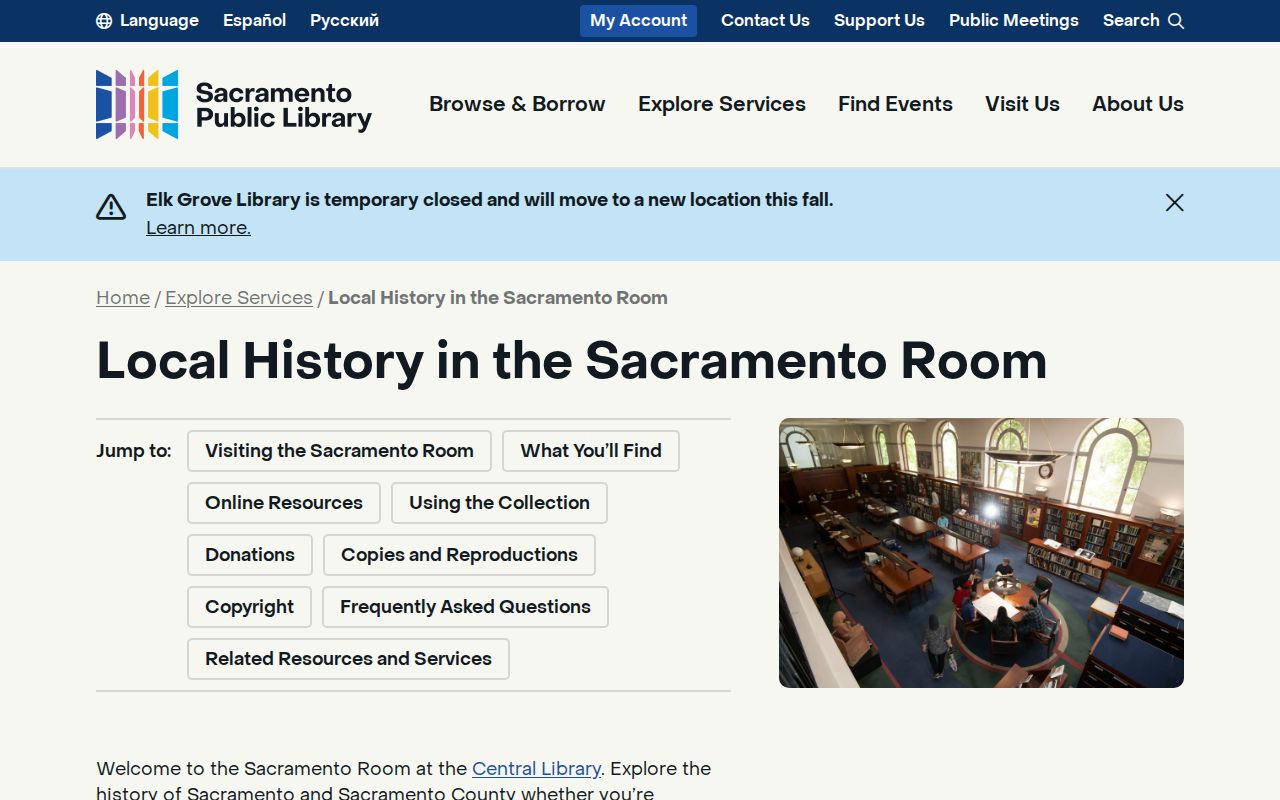
The Sacramento Room adds a library setting to the archive trail, with staff help for material that is not on the open shelf.
Why 1851 Matters in Sacramento
James Horace Culver's Directory for the Year 1851 was the first book published in Sacramento and the first West Coast city directory to list numbered street addresses. That distinction gives the earliest Sacramento city directory more than family-name value. It shows a young city choosing a way to tie people, businesses, and numbered places together while the Gold Rush-era record system was still taking shape.
Early entries can also say where a newcomer came from. Later volumes lose that place-of-origin field, but gain other clues such as spouse names, business addresses, telephone numbers, owner or renter marks, and reverse street access. A researcher can therefore use an early entry to test identity, a middle run to follow movement, and a later book to find a number or listed neighbor.
CSH government records reach back to 1849, so directory work can sit beside recorder, assessor, court, and city series rather than floating apart from them. The first book is a local record-keeping story and a practical starting point for any household trail that reaches into Sacramento's earliest years.
Publishers Across Sacramento Directory Years
Publisher names help identify the run, but they should be copied as printed on each volume. The local sequence includes Culver's 1851 book, Sacramento Directory Company editions, and R. L. Polk or Polk & Sons after 1974. A bound volume may gather years or carry a cover date that differs from the span a library shelf uses. Record the title page, imprint, edition year, and page number together.
Publication is not continuous across every year from 1850 to 1990. The right search plan is to choose the nearest available volume, work backward and forward, and mark the gap rather than filling it with an assumption. The later telephone series extends the local listing trail through 2019, but it is not identical to the earlier city directory format.
| 1851 | Culver's Directory for the Year 1851, Sacramento's first published book and a West Coast first for numbered street addresses. |
|---|---|
| 1850-1990 | City-directory run held by CSH MS0031, with missing years possible and publishers changing across editions. |
| After 1974 | R. L. Polk or Polk & Sons appears in the later local publisher history. |
| 1967-2019 | Telephone books continue the collection after the printed city-directory era, with subscriber and address entries as printed. |
Publisher and series are clues to where a page belongs. They do not change the rule for reading the entry: preserve the original wording, then verify the person or address through an independent Sacramento source.
How Sacramento Directory Entries Speak
A Sacramento city directory entry is compact, but it can carry several identity clues. The archive's sample inspection documents an individual or business name, residence or business address, occupation and business address, and often a spouse. The research guide adds owner or renter notation and abbreviation conventions. Later books can include a telephone number. An entry may be name-first or address-first, and the same household can appear in more than one form.
| Name | Individual or business name, with a spouse or widow notation when the volume records it. |
|---|---|
| Residence | House number and street as printed; the reverse section changes the order to street, number, then listing. |
| Occupation and business address | Historical field that can separate people with the same name and point to a second location. |
| Owner or renter mark | A clue supplied by some runs; preserve the volume's symbol or abbreviation rather than modernizing it. |
| Telephone | A later-book listing that may connect a name, number, and address for that edition only. |
| Place of origin | An identity clue found in some earliest entries and not a feature to expect in every later volume. |
- Criss-cross directory
- A street-order section that lets a reader move from street name to number and then to the listed resident or business.
- Householder index
- The name-first portion used to locate a head of household or listed adult before checking the address details.
- Abbreviation key
- The volume's guide to short marks for residence, spouse, widowhood, occupation, and business location; consult it before interpreting a symbol.
- OCR
- Machine-read text from a scan. It speeds a search but can misread small type, so the page image controls.
Absence from one Sacramento city directory means only that the person is not listed in that edition. Relocation, death, an omitted enumeration, another adult's name, or an unlisted phone can all explain a blank.
The 1914 Sacramento Reverse Section
1914 is the key functional turn in the Sacramento city directory run. From that point, the reverse section organizes listings by street name and house number. A known address can therefore lead to a listed resident or business without first knowing a surname. The same pages can show other listed entries along the street, although apartment and unit handling varies by edition.
Before 1914, the address path is less direct. Use an alphabetical name entry, property records, census enumeration, or a known owner or resident, then compare the address as printed. When a street name or number changes, the legal description, cross streets, subdivision, map, and APN help test continuity. There is no single official citywide street-renumbering concordance in the research record, so a neat match is not proof of an unchanged address.
This reverse-shelf quirk makes the city directory useful for two different questions. Name-first searching follows a person across years. Street-first searching reveals the listed occupants and businesses attached to one number at a particular time. Neither method establishes a complete household or current residence.
Where Sacramento Directories Are Digitized
The Internet Archive Sacramento directory collection provides the digitized run for broad name and page searches. OCR can find a rare surname quickly, but old type, bleed-through, broken lines, and street abbreviations create false misses. Open the scanned page, check the volume title, and record the page image instead of relying on the OCR text alone.
The detailed OAC finding aid for MS0031 describes the 1850-2019 directory and telephone-book collection, its 196 volumes and 29 reels, and its open research status. The finding aid was refreshed and newly indexed in July 2026. CSH also offers digital catalog routes through OAC, Internet Archive, and PastPerfect, while originals and some microfilm remain an on-site option. Research contact is csh@cityofsacramento.org or 916-808-7072.
A failed scan does not end the search. Compare another digital page, ask CSH staff about the volume, or use the Sacramento Room for a physical copy or microfilm reader. Keep the search terms, spelling variants, and date of access in the research note.
The CSH directory and telephone-book finding aid is the best index for deciding which volume or reel to seek next.
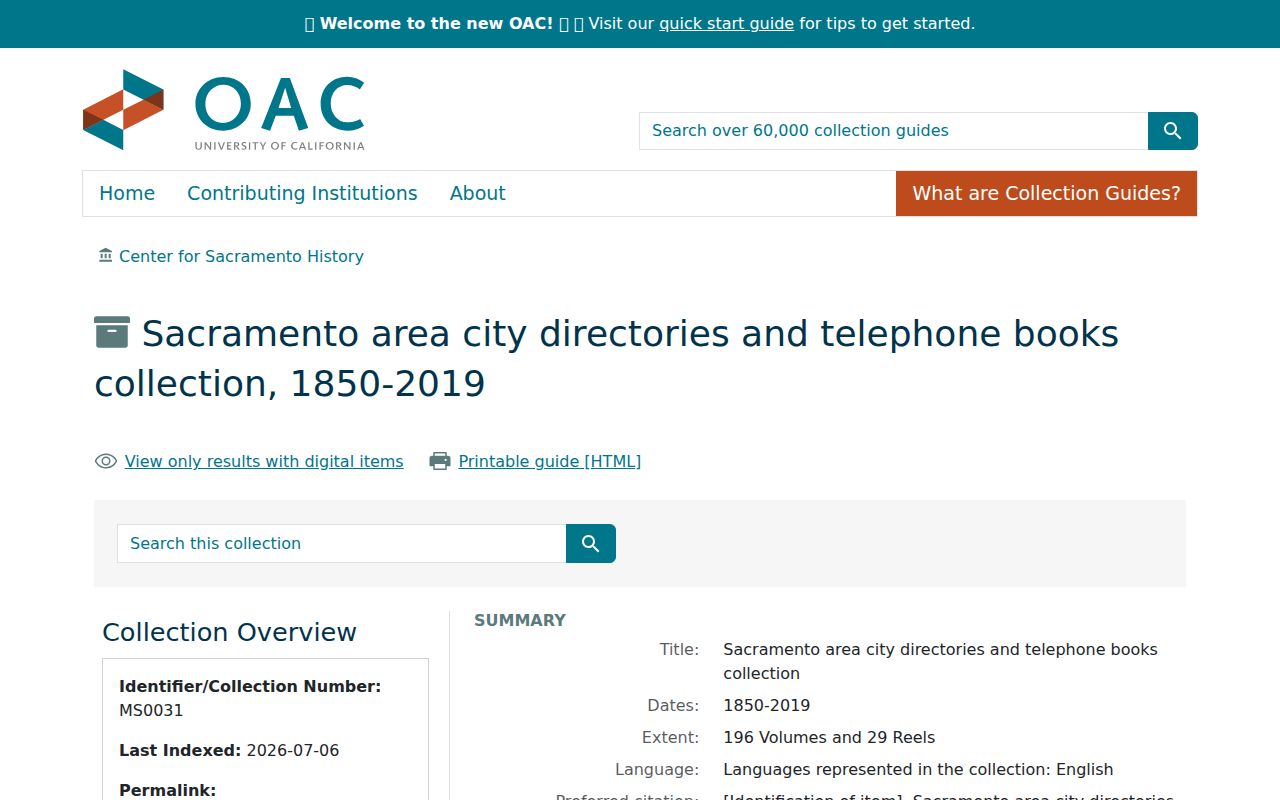
The finding aid links the digital search to the physical collection and helps prevent a missing scan from being mistaken for a missing year.
Following a Sacramento Household Through Years
Tracing a household works best when each directory year is treated as a dated snapshot. Start with the closest known name or address, preserve the exact form, and pair the annual clue with a census year or a deed event. A move can be bracketed by the last address in one volume and the first address in the next. A widow notation can suggest a death, but it needs death, cemetery, obituary, or probate support.
- Search the surname and spelling variants in the nearest available volume, then check the scanned page against the OCR.
- Record the name, spouse, occupation, address, owner or renter mark, page, edition, and any business location.
- Move one volume backward and forward to mark a changed address, new spouse notation, disappearance, or return.
- After 1914, check the reverse section for the same number and nearby listed entries; before 1914, use alphabetical entries and census evidence.
- Pair the directory snapshots with federal schedules, deeds, permits, newspapers, cemetery records, or probate before calling the trail complete.
Federal census schedules from 1850-1950 are public in 2026 under the 72-year rule, and the 1960 census is due in 2032. Census relationships, ages, occupation, and ownership or rent fields can fill gaps between annual directory snapshots. The two sources are not duplicates: a census records an enumeration moment, while a directory records a publication listing.
If a person vanishes, test several explanations. A new street address may mark a move. A widow notation may narrow a death window. A directory gap may be a missing publication or an unlisted household. The source trail, not the blank alone, decides which explanation is sound.
Pairing Directories with Sacramento Records
Directory entries become more useful when paired with records that answer a different question. Recorded deeds and the assessor roll address title, APN, situs, and mailing destination. City permits and LILA add project dates, scope, land-use context, and public applicant or contractor fields. The 1895 Sacramento Sanborn atlas has 44 sheets that show footprint, construction material, use, and address context. A Sanborn label is not a resident name, but it can show whether a building and number fit the directory entry.
The Sacramento Room's more than 100 regional-school yearbook titles can support a classmate trail. Newspapers, including the Sacramento Bee and historic Sacramento Union, can link a name to an obituary, notice, or property event. CSH coroner records cover 1850-1977, and naturalization records cover 1850-1955 in several court record groups. The archive's researcher guide also identifies Homestead Records from 1860-1929 and a 1976 survey of qualifying pre-1920 homes in old city boundaries.
Use the CSH researcher resources guide to choose a house-history or person-history fallback. The guide's value is procedural: it connects a person, property description, date, building history, and archival series without assuming that a listed occupant held title.
When a directory result and an official record disagree, preserve both entries and ask what each source was designed to record. A deed can outlast a directory listing. A directory can show a household that never appears as a property owner. A yearbook can establish school association while leaving the later address unknown.
Sacramento Phone Books After 1967
Telephone books extend the Sacramento listing trail from 1967 through 2019, after the main printed city directory run reaches its 1990 endpoint. MS0031 keeps the phone books with the city directories, so a later number or listed address can be compared with an earlier name-first entry. The phone series is still a publication snapshot. It may omit a household, use a business number, or show an address that changed after the edition closed.
For a recent historical clue, record the name, number, address, edition, page, and whether the entry is personal or business. Compare it with a deed, assessor field, city record, license filing, obituary, or a later directory. Do not treat a phone listing as a current resident confirmation, and do not infer that every person at an address shared the listed number.
The Sacramento Public Library genealogy service provides a second access path to databases and local-history programs. Vendor access varies. Ancestry Library Edition, HeritageQuest, Fold3, American Ancestors, Digital Sanborn Maps, and Newspapers.com World Edition have different authentication or in-library limits. CSH and the Sacramento Room remain the right fallback when a licensed search does not include the volume or page.
The Sacramento Public Library genealogy resources page helps match a directory question with census, newspaper, map, and family-history databases.
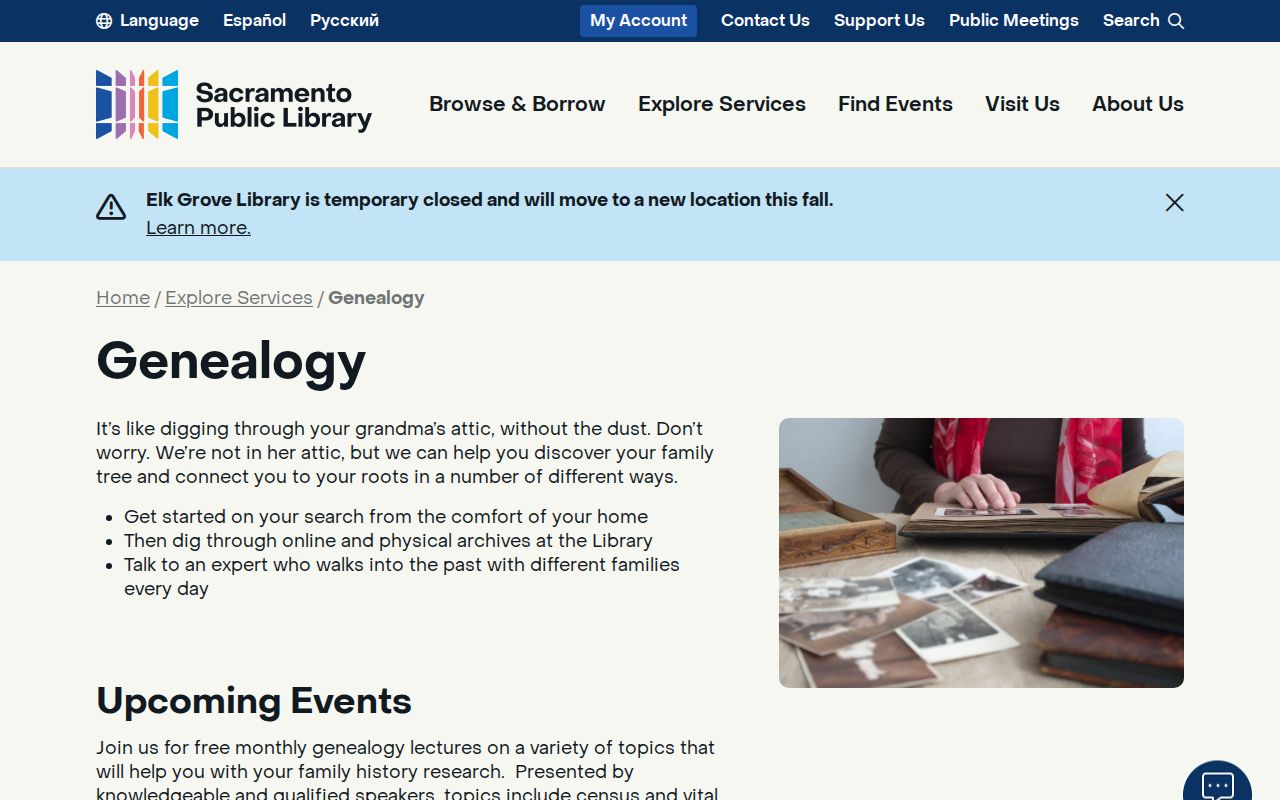
Library databases can widen a historical search, while the original Sacramento city directory or phone-book page remains the source to cite for the printed listing.