
Starting the Sacramento Residents Directory Search
Sacramento is both the county seat and California's capital, so a resident trail can cross city, county, state, court, library, and archive systems. The right first step depends on the clue in hand. A street address points toward the Sacramento County Assessor Parcel Viewer and its APN. A recorded transaction points toward the Clerk/Recorder index. A current voter needs an individualized state check, while an older household may require a Sacramento city directory, census schedule, newspaper, or yearbook. Treat each result as one layer of evidence, not as a complete resident roll.
The Sacramento residents directory is most useful when ownership, listed residence, and public affiliation are kept separate. An assessment roll may show an owner and a mailing destination. A city permit may name an applicant or contractor. A directory may show a listed occupant, spouse, occupation, or phone number. None of those fields, by itself, proves that every person in a household lives at the address today. Start with a narrow purpose, save the source and date, and stop when the evidence no longer supports a lawful personal need.
- Write down the known name, former name, address, likely era, and any spelling or street-number variants.
- Use the county parcel tool for an address or APN, then note the situs, parcel geometry, and limited characteristics.
- Move to the recorder's party-and-year index for deeds, liens, reconveyances, and related instruments.
- Use the state voter-status check, court search, business filing, license record, or historical shelf that matches the question.
- When an online trail ends, contact the custodian, library, archive, or public-records desk with a clear date range and record description.
Where Sacramento Keeps Resident Records
Four offices form the core of a Sacramento resident search. The Clerk/Recorder holds the recorded-document index and vital-record services. The Assessor ties a situs address to an APN and keeps fuller ownership fields at the office or through a focused request. Elections handles individualized voter status and approved file orders. Court, city, state, library, and archive systems add different kinds of corroboration. The Sacramento residents directory is therefore a path through custodians, not one master database.
Sacramento County Clerk/Recorder
Recorded documents, marriages, and vital-record services
916-874-6334
Index online; copies by office, mail, fax, or order
Sacramento County Assessor
Parcel, APN, assessment, owner, and mailing fields
Parcel Viewer online; owner fields at the office or through NextRequest
Address and APN are the public web search keys
Sacramento County Elections
My Voter Status and approved voter-file products
916-875-6276
7000 65th Street, Suite A, Sacramento, CA 95823
For a whole street, the address chain deserves its own sequence of parcel, deed, map, and historical sources. The Sacramento street directory page keeps that by-address work distinct from a name-first search.
Sacramento Parcel Viewer as Address Anchor
The Sacramento County Assessor Parcel Viewer is the cleanest place to turn a street address into a stable research key. Search the normalized situs address or APN, then save the parcel number before comparing any other source. The map can show the subject polygon and nearby parcels, while the online card may return the situs, assessed values, limited characteristics, and geometry. Owner names are intentionally absent from the web viewer because of privacy concerns.
The viewer's search fields answer different questions. Address locates the taxable parcel. APN avoids many spelling and street-suffix problems. Map navigation lets a researcher click neighboring geometry. Layers and basemaps add context when available, but they do not turn a map into a household roster.
| Address | Text or autocomplete search for the situs or property address. |
|---|---|
| APN | Assessor's Parcel Number, used as a more durable parcel key. |
| Map navigation | Pan, zoom, and click parcel geometry; adjacent parcels can be inspected one at a time. |
| Layers and basemap | Map controls that provide parcel context when the viewer makes them available. |
- Parcel
- A mapped piece of land identified by an APN, with a situs address and geometry.
- Roll
- An official list maintained for a stated purpose, such as assessment or voter registration, not a complete household census.
- Index
- A finding aid that points to a record by name, date, type, or identifier without necessarily showing the document image.
- Criss-cross directory
- A historical directory section arranged by street and number, useful for listed occupants but not proof of title.
The full public assessment record can include secured-roll owner, mailing address, exemptions, tax-rate area, zoning and land-use codes, recorder references, maps, and characteristics. Request those fields at the assessor counter or through NextRequest. A mailing address is a delivery destination, not proof of a current residence.
See the official Parcel Viewer instructions and disclaimer before treating a map result as final.
Open the Sacramento County Assessor Parcel Viewer before the image to see how an APN keeps a Sacramento residents directory search tied to the parcel rather than to a guessed name.
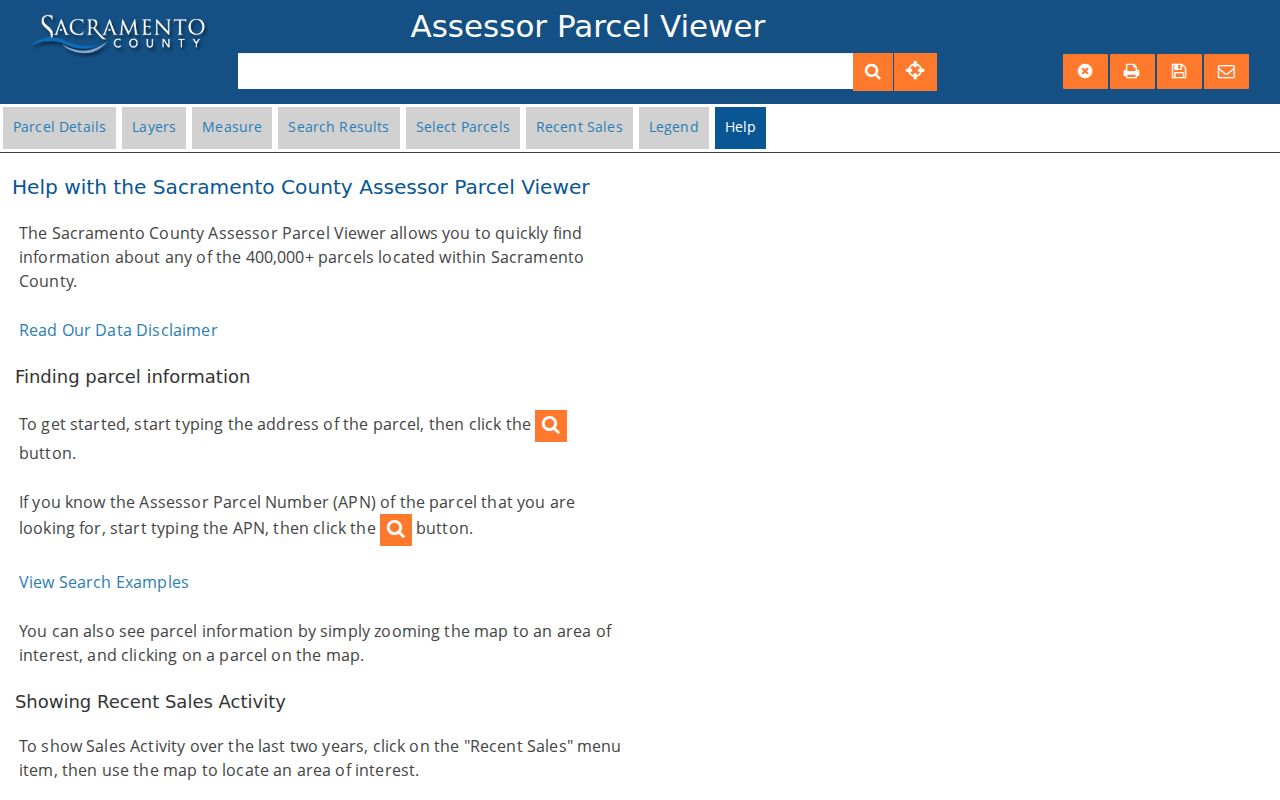
The county parcel screen is a useful first view, but the missing owner field is a cue to use the assessor's documented counter or request channel.
Sacramento Deeds from 1849 Forward
The Sacramento County Clerk/Recorder's recorded-document index reaches back to 1849. Its public value is metadata: party names, recording year or date, document category, and a book/page or instrument reference when shown. It is not an online image library. Search the owner as a grantee, then search the seller as an earlier grantee, and compare the legal description or recorder reference as the chain moves backward.
Search both sides of each transfer. A grantor is the party conveying an interest; a grantee receives it. The index can point to a deed, deed of trust, reconveyance, assignment, or lien, but it does not by itself show the full text, signatures, consideration, or complete legal description. At the 1849 boundary there is no earlier Sacramento County recorder index.
When an instrument is needed, the copy route includes a completed order by mail or fax, a visit to either office location, or a call to 916-874-6334. The copy guidance says documents recorded since 1850 may be viewed at either office, while the online index describes coverage from 1849. Preserve that one-year distinction in notes rather than smoothing it away.
Indexed party name, recording date or year, document type, book/page or instrument number, and image availability are the key fields to capture. The last field will normally direct the researcher to an office or copy order, because images are not available in the public web index.
A Sacramento deed trail can confirm a recorded transaction. It cannot turn a title event into proof of who occupied the parcel at that time.
Open the Sacramento County Clerk/Recorder service hub before ordering a copy or certificate.
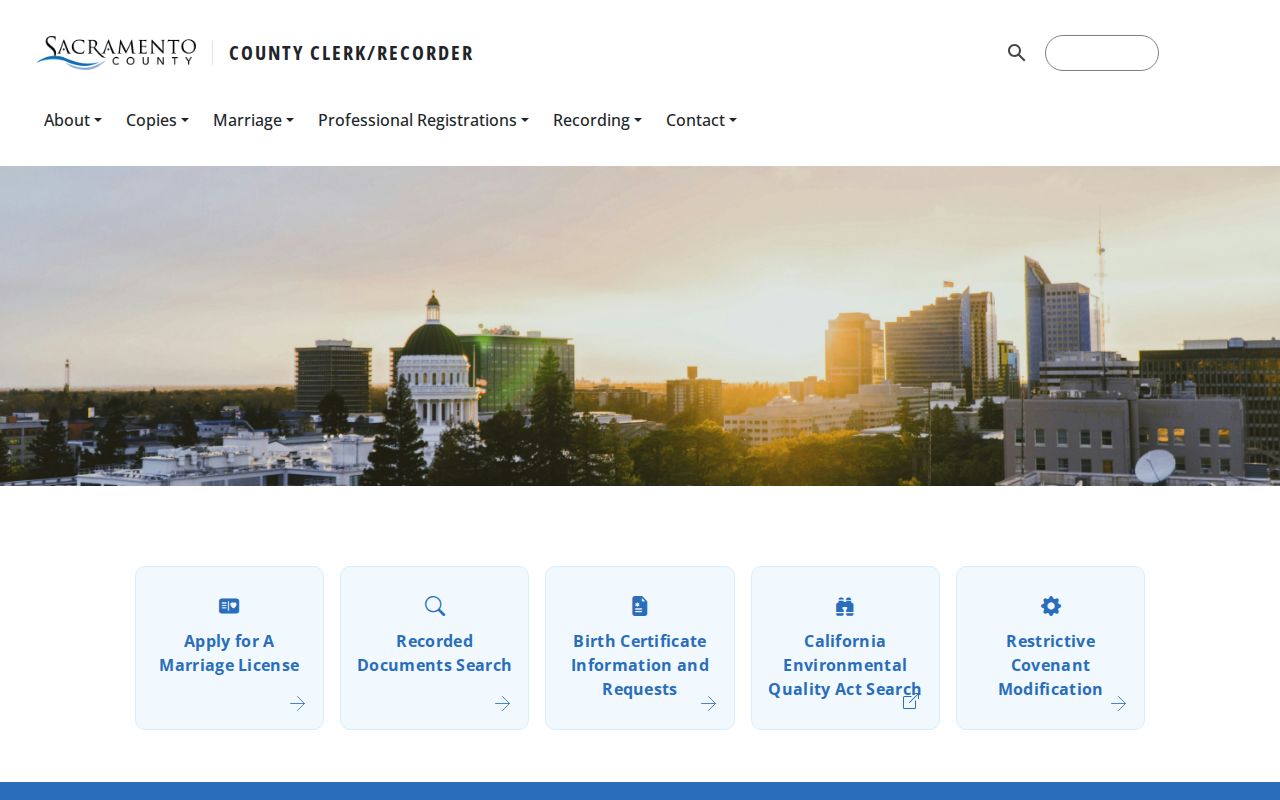
The Clerk/Recorder service hub connects the index to the copy, marriage, and certificate routes that finish the record request.
Sacramento Court Search by Era
Sacramento Superior Court uses several search systems rather than one universal name directory. The court search gateway separates criminal, civil, family, probate, traffic, and historical modes. Criminal public access covers Sacramento filings from 1989 to the present. The historical search covers civil matters from 1936-1995 and probate from 1948-2007. Newer civil documents begin after November 13, 2007, while trust and estate material in the probate portal begins after February 5, 2007.
Search criteria matter. A criminal name search can return several people with the same name and cannot fingerprint-identify a subject. A case-number search is Sacramento-specific. Family search can use a name, case number, or filing date, while traffic search uses a driver-license number, citation, or case number. Account creation is prompted for civil and probate portals, and remote views exclude sealed, juvenile, adoption, and confidential family or probate material.
A public result may show the case number, title and party names, filing date, case type or status, register of actions, hearing details, and public document links when remote access is allowed. Civil files before the electronic cutover may be off-site and take about 10 business days to reach downtown; mailed civil requests often take 4-6 weeks. Staff search over 10 minutes costs $15, copies are $0.50 per page, and certification is $40. The court's free courthouse kiosks can expose material withheld from internet display, so kiosk verification is a useful fallback.
The court reported a 2023 Civil and Probate migration, followed by Small Claims and Limited Civil integration on June 17, 2024. Transitional gaps are acknowledged. Support lines include Civil at 916-874-5522 option 3, Probate at 916-875-3400 option 2, and Small Claims/Limited Civil at 916-875-7746.
What Sacramento Voter Records Can Confirm
California's My Voter Status service is an individualized check, not a public Sacramento residents directory. A voter supplies first name, last name, date of birth, and a driver-license, California ID, or system-requested Social Security digits. The result can confirm registration status, party preference, vote-by-mail status, polling or vote-center information, and election participation information. It does not reveal ballot choices, and signatures, full Social Security numbers, and driver-license numbers are withheld.
Sacramento County's voter file is a different access channel. An applicant must state identity, contact details, requested product or geography, a permitted election, scholarly, journalistic, political, or governmental purpose, and driver-license identification. Orders go in person or by mail to Voter Registration and Elections, Campaign Services, at 7000 65th Street, Suite A. The standard file is $80, a custom file is $105, and activity subscriptions are $308 for four weeks or $616 for eight weeks. Approved orders are ready within 72 business hours.
The applicant agrees not to sell, lease, or deliver the information without written county authorization and must follow Elections Code sections 2180-2194. A requested geography can include a ZIP or precinct, but it is not an unrestricted street roster. Safe at Home and confidential-registration rules shield qualifying voters. A status lookup can answer a person's own question; it cannot support a casual browse of every Sacramento household.
Open the California My Voter Status lookup before the image to see the individualized route.
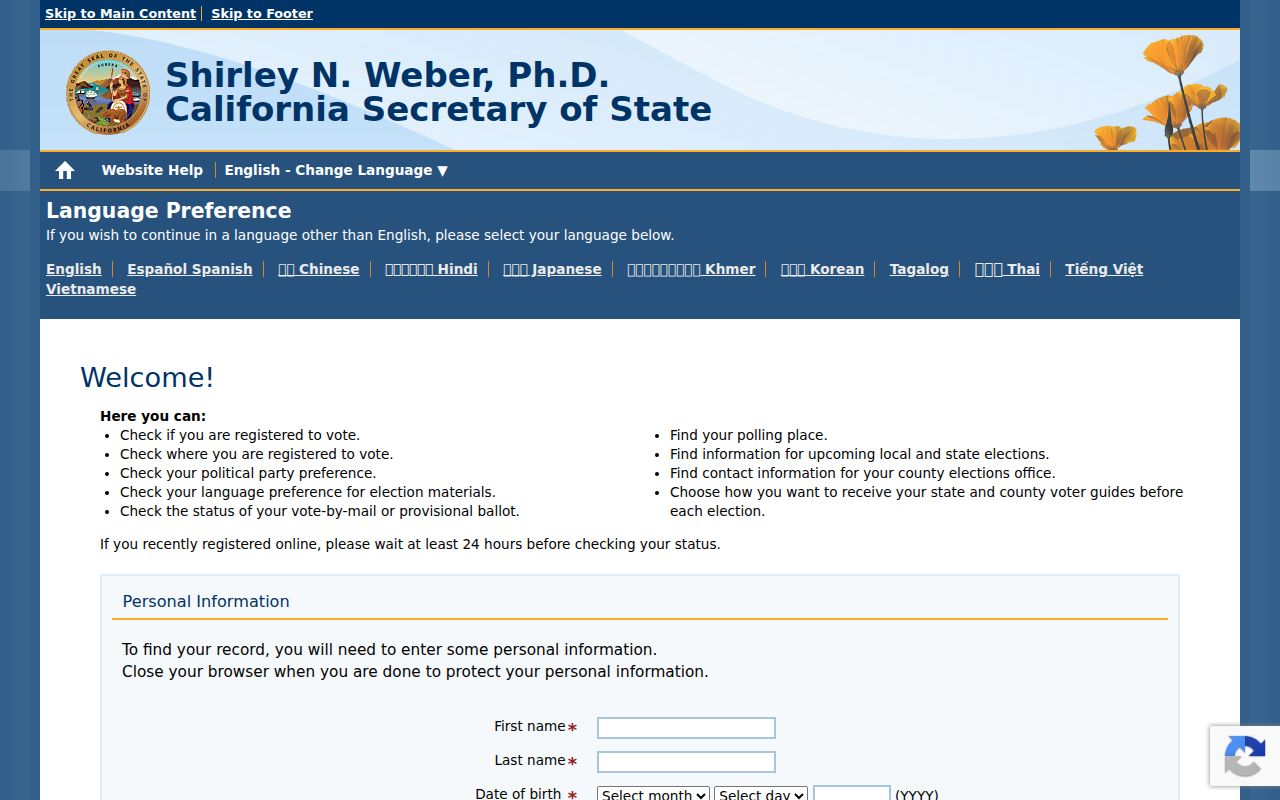
The state lookup shows why voter information belongs in a verification step, not as a substitute for a public name directory.
Sacramento Vital Events and Copy Rules
For Sacramento events, the county Recorder is the best first stop for county birth, death, and public-marriage certificates. The county Clerk controls confidential marriages. CDPH Vital Records maintains statewide birth, death, fetal death or stillbirth, marriage, and divorce records. A divorce certificate is a limited vital event record; a substantive decree comes from Sacramento Superior Court. The custodian changes with the event, so a name match should be followed by the correct form and eligibility check.
The CDPH Vital Records service provides the statewide forms and copy rules that supplement the county route.
California does not use a simple rule that closes births for one number of years and deaths for another. Under Health and Safety Code sections 103525-103526, an authorized certified birth or death copy requires statutory eligibility and a notarized sworn statement. Anyone may order an informational copy, but it is marked not valid to establish identity. Confidential marriage access is limited by Family Code section 509, and adoption files are confidential under Family Code section 9200.
The VS 111 birth, VS 112 death, and VS 113A marriage forms ask for applicant details, subject names, event date and place, related parents or spouses, copies, and purpose or relationship. Mail requests need notarization, payment must be a check or money order payable to CDPH Vital Records from a U.S. bank, and cash is not accepted. The accepted fee is retained as a search fee if no record is found. For 2026, the state fees are $31 birth, $26 death, $19 marriage, and $18 dissolution. CDPH uses First Class Mail, does not refund accepted orders, and directs readers to its live processing page for current timing.
When a certificate is closed or too narrow, historical substitutes include CSH coroner records, cemetery evidence, newspapers, church registers, census schedules, probate, and directory entries. Birth-parent research must use lawful state adoption-information and reunion routes rather than trying to infer a protected identity from a restricted file.
A vital record can establish an event under its access rule. It is not a general list of all Sacramento residents.
A Sacramento Heir Trail from Probate
Heir research is one of the clearest human uses for a Sacramento residents directory search because each step can be tied to a custodian. Begin with a probate case name or filing date. Read the public petition, inventory, order, or other available filing for the decedent, petitioner, estate, and heir context. Then compare any recorded transfer or affidavit with an obituary or death record. A case can point to the next record; it does not make every family detail public.
The clean trail is probate to public filing to recorded transfer to obituary or death evidence. A court kiosk may show a document that a remote view withholds, while sealed or confidential filings remain outside general access. If an estate matter is older than the historical court search, ask the Center for Sacramento History about transferred court and government series. Keep a source date for each link in the chain and distinguish a confirmed filing from an inference.
Recorded transfers may identify a successor interest, but a deed or affidavit does not prove that the named person lived at the property. A published obituary can connect relatives and burial details, yet it should be checked against official death or probate evidence. This careful sequence supports family history and estate work without exposing unrelated household members.
Current Sacramento Resident Sources
Different Sacramento sources list different kinds of people. The table below keeps the word directory broad enough to include ownership, public filings, civic contacts, and historical listed residents without treating any one source as a complete current household list.
| Source | Who It Can List | Keeper | Access |
|---|---|---|---|
| Full assessment roll | Owner and mailing destination | Sacramento County Assessor | Counter or focused NextRequest |
| My Voter Status | One voter's registration and status | California Secretary of State | Individual verification |
| Recorded-document index | Parties to deeds, liens, and related instruments | County Clerk/Recorder | Free metadata from 1849 |
| City records library | Names in agendas, commissions, contracts, and correspondence | City Clerk | Online search or CPRA request |
| Neighborhood directory | Association officers, boundaries, and meeting details | City of Sacramento | Public civic directory |
| CSH and Sacramento Room | Listed residents in directories, yearbooks, and historic files | Archive and library | Digital, catalog, or in person |
Official records and commercial compilations also differ in how a result can be checked. The comparison matters when a name search returns several possible people.
| Research path | Strength | Limit to keep in mind |
|---|---|---|
| Official custodian record | Named keeper, stated coverage, and a request or source-image route | Access can be narrow, offline, fee-based, or limited by privacy law |
| Commercial people-search compilation | May combine many public and marketing data sources in one interface | Names can be merged or stale, costs can change, and the result is not a certified record |
Use an assessment roll for a title or mailing clue, a recorder index for a recorded event, a city file for civic context, and a historical directory for a past listing. The differences keep the Sacramento residents directory honest: a record can be public while the conclusion drawn from it remains limited.
Sacramento Business and License Corroboration
Public business and professional records can help separate people with the same name or connect a person to a Sacramento organization. The California Department of Consumer Affairs license gateway can route a search to many boards, including medical, nursing, contractor, real-estate, barbering, and cosmetology systems. Results commonly show a licensee or business name, number and type, status, issue or expiration dates, address of record, and public discipline. The State Bar attorney search is separate.
California Secretary of State bizfile adds corporation, LLC, LP, and nonprofit records. A search or recent filing PDF can show entity name and number, formation date, status, jurisdiction, street or mailing address, agent for service, and statement due date. The system has more than 17 million documents, but keyword results cap at the 500 closest matches. Advanced Search adds entity type, status, and initial filing-date ranges. LLP and GP filings are omitted from the online set and require a paper route. An agent for service is not necessarily an owner or resident.
Use these records as corroboration, not as a personal address directory. Match the entity number, filing date, board, license type, or agent field before treating two names as one person. A city permit or business record may name an applicant, architect, contractor, or representative whose connection to a household is not stated.
The California Department of Consumer Affairs license search provides the board gateway for this kind of check.
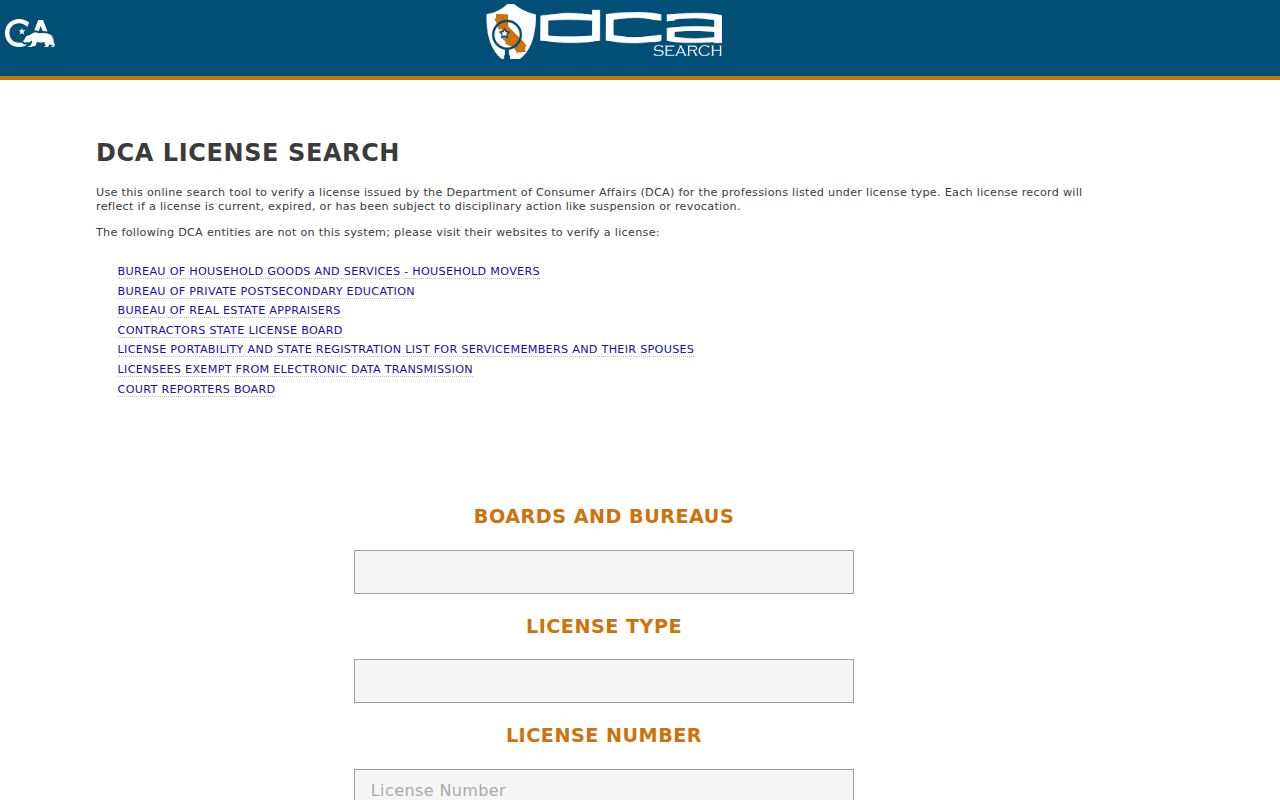
A license result adds a dated public credential and address of record, which can be compared with a separate Sacramento record without turning either into proof of residence.
Open the California Secretary of State bizfile search before the image when an entity filing is the corroborating record.
Bizfile filings can add an entity number and filing history to a same-name check, while its own warning about completeness still matters.
When Sacramento Online Search Ends
An online result is often an index, not the record itself. When a parcel owner is withheld, a deed image is absent, a court cutover leaves a gap, or a city search cannot find a legacy item, the next step is a focused request. Under the California Public Records Act, Government Code sections 7920.000 and following, any person may ask an agency for an identifiable existing record. An agency ordinarily determines disclosability within 10 calendar days and can add a 14-day extension for unusual circumstances. Production still follows within a reasonable period, not on a fixed ten-day delivery promise.
Describe the name or address, department, record type, date range, and preferred format. Ask for segregable nonexempt portions if some material is withheld, and request the exemption citation in writing. Direct duplication costs can apply, and specified programming or extraction costs may apply to electronic data. The City Clerk is the fallback for city records when the modern records library does not carry a legacy item. Archive and library reference desks are the parallel fallback for transferred historical material.
The City records AppLauncher announces a move to a modernized records library. Save the search date and preserve a result or error screen when a record is missing. That small habit makes a later request clearer and helps distinguish a true absence from a migration gap.
The California Public Records Act guidance explains the deadline, exemption, fee, and request framework that applies to the next channel.
Open the City of Sacramento public records library before the image when the request concerns a city file.
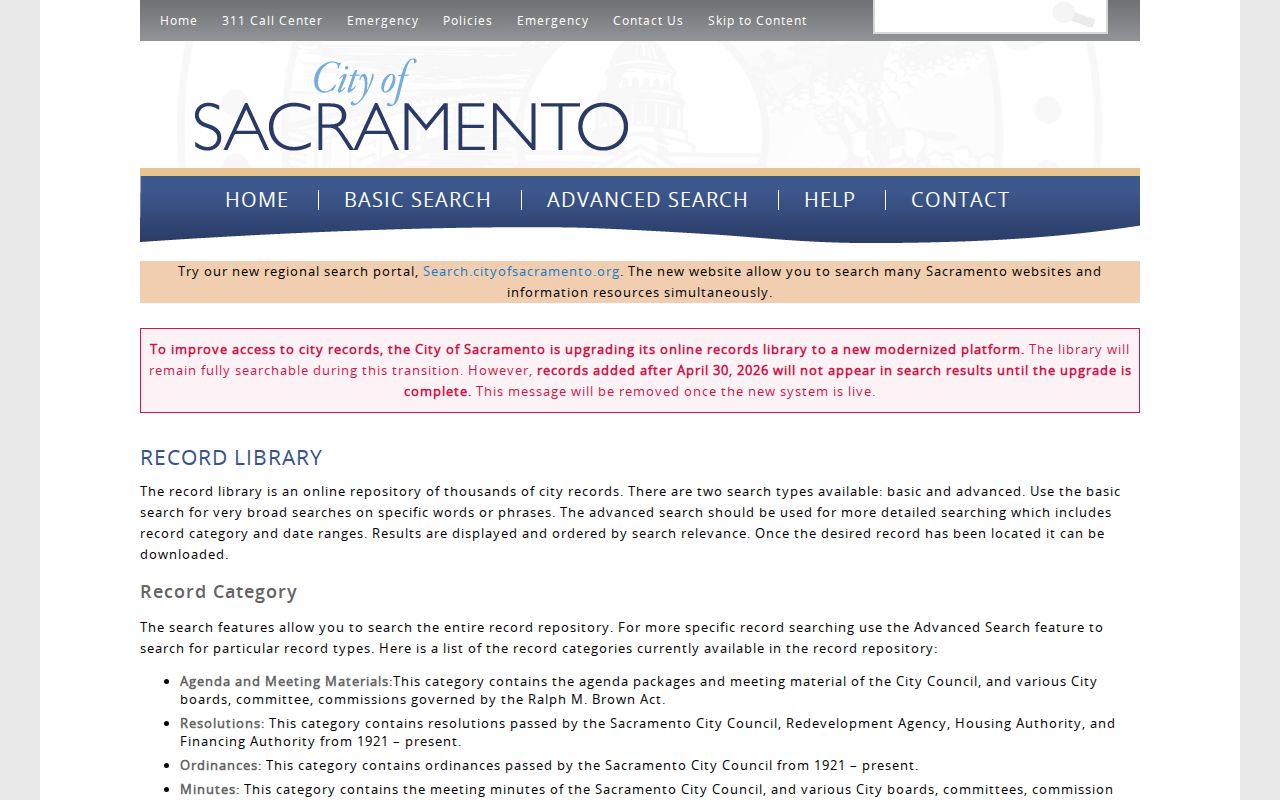
The city library screen is a useful first pass, while a City Clerk request remains the documented route when a legacy record does not migrate cleanly.
Sacramento Room and CSH Research Desks
The Sacramento Room occupies the second floor of Central Library in the original 1918 Carnegie Reading Room. Its local-history shelves include city, county, and telephone directories, maps from the 1880s through the early 2000s, more than 100 regional-school yearbook titles, photographs, street and neighborhood pamphlet files, periodicals, and manuscripts. No appointment is required, though advance email helps staff retrieve vault material. Library databases include Ancestry Library Edition, HeritageQuest, Fold3, American Ancestors, Digital Sanborn Maps, and Newspapers.com World Edition, with access terms that vary by vendor and location.
The Center for Sacramento History is the deeper city and county repository. Its government documents reach to 1849, and its catalogs divide material among OAC finding aids, Internet Archive items, and a PastPerfect catalog of about 75,000 entries. The collection includes directories, phone books, assessor and recorder materials, coroner and naturalization records, photographs, business papers, and community collections. CSH is at 551 Sequoia Pacific Blvd., Sacramento, CA 95811; research contact is 916-808-7072 and csh@cityofsacramento.org.
These desks are especially useful when a name leaves the current rolls. A yearbook can anchor a classmate, a street pamphlet can explain a neighborhood label, and a newspaper notice can lead to probate or cemetery evidence. A historic directory is still a dated listing, so pair it with a second source before treating the identity as settled.
The Sacramento Room local-history guidance describes the library access point for directories, maps, yearbooks, and related collections.
Open the Center for Sacramento History collections before the image to see the archive's catalog and digital routes.
CSH's catalog and research desk connect present questions with city and county series that are not all exposed through a single online search.
Sacramento ZIP Geography Changes the Custodian
A Sacramento postal city is wider than the incorporated city. ZIP codes 95821, 95825, and 95864 commonly carry a Sacramento mailing name while covering unincorporated Arden-Arcade or Sierra Oaks areas. Parts of Rosemont, Florin, Foothill Farms, and the southeast edge also cross city, county, or another municipal boundary. That geography changes which office keeps permits, code files, police records, or neighborhood contacts.
Use USPS to verify the delivery point, then test the address in City LILA or the county GIS and record the APN. The ZIP is a carrier-routing construct, not a legal boundary. For older research, do not project modern ZIPs backward before the postal ZIP system began in 1963. Use the period street address, ward or precinct, subdivision, map, and census enumeration district instead.
Central city ZIPs align well with the numbered and lettered grid, while Natomas, Land Park, Pocket, and fringe areas need more care with rivers, subdivisions, annexation history, and unincorporated pockets. A Sacramento residents directory search should label the jurisdiction from the parcel or city tool, not from the preferred postal city alone.
Sacramento Privacy Limits and Safe Search
Some public records are intentionally narrow. California voter records with signatures, Social Security numbers, and driver-license numbers are withheld. DMV personal information is constrained by the federal Driver's Privacy Protection Act. Safe at Home gives eligible survivors and specified reproductive-health participants a substitute mailing address under Government Code sections 6205 and following, though it does not erase every historic record. Real-property legal descriptions can still expose a location when a person buys property in their own name. Adoption files remain confidential under Family Code section 9200.
The Sacramento County Sheriff's Inmate Information search has name and XREF modes and describes live custody information. A booking is evidence of custody at a time, not proof of a residence or a conviction. Megan's Law carries an anti-misuse warning, and California stalking law can apply when address or family details are used to follow, threaten, or harass. Verify any concerning result with the responsible office rather than repeating an unverified name.
Open Sacramento Sheriff Inmate Information before the image to see the name and XREF search modes.
The sheriff search is a narrow custody tool, and its limits show why sensitive results should not be widened into a general resident profile.
Earlier Sacramento Directories in Context
Sacramento's historical directory shelf runs from the area's 1850-1990 city directories, not every year, into telephone books from 1967-2019. The Center for Sacramento History's MS0031 finding aid describes 196 volumes and 29 reels. Its digital run is valuable because all city-directory volumes are digitized, while original and some microfilm material remains available for research. The Sacramento Room adds city, county, and telephone volumes, yearbooks, maps, and newspapers.
James Horace Culver's Directory for the Year 1851 was Sacramento's first book and the first West Coast city directory to list numbered street addresses. From 1914, the reverse section lets a researcher browse by street and house number. Earlier years require alphabetical entries, property records, census enumeration, or a known resident. The earliest entries can even state where a newcomer came from, an identity clue that later directories dropped.
For the full historical shelf, entry fields, publishers, OCR checks, and household workflow, use the Sacramento city directory collections page. A directory can show a listed resident, spouse, occupation, owner or renter mark, and address as printed. It cannot replace a deed, vital record, or current custodian record.